Mastering Chess Tactics: How to Use Pins, Forks, and Skewers to Win Games
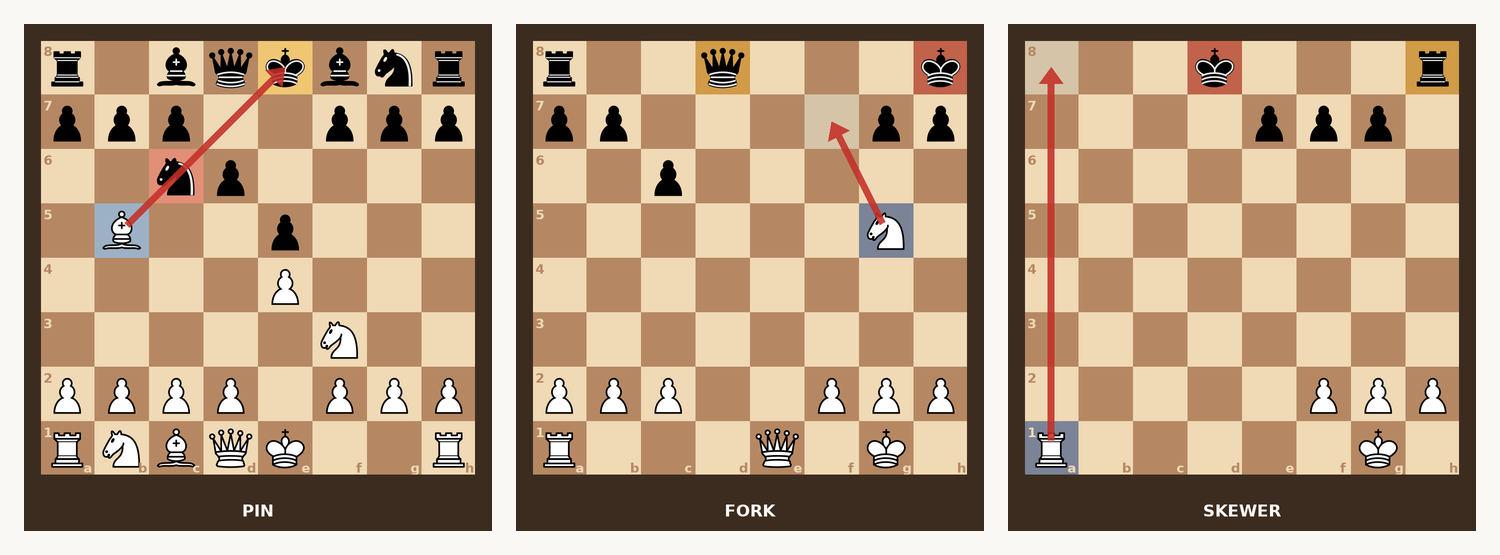
A pin freezes an enemy piece because something more valuable sits directly behind it on the same line. A fork is one move that attacks two or more enemy pieces at once, so only one of them can be saved. A skewer is a pin in reverse: the valuable piece is in front, you attack it, it must move, and you capture what it was shielding. All three win material by creating two problems with a single move, and all three come down to noticing that two enemy pieces are standing on the same rank, file or diagonal.
What's inside this article
Tactics are the part of chess where games are actually decided. At club level, a game is far more often lost because somebody left two pieces on the same diagonal than because of a subtle strategic error thirty moves earlier. The good news is that the overwhelming majority of those moments come from three patterns, and all three can be learned in an afternoon.
This guide covers the pin, the fork and the skewer: what each one is, the different types, worked examples on real boards, and — the part most guides skip — how to defend against them.
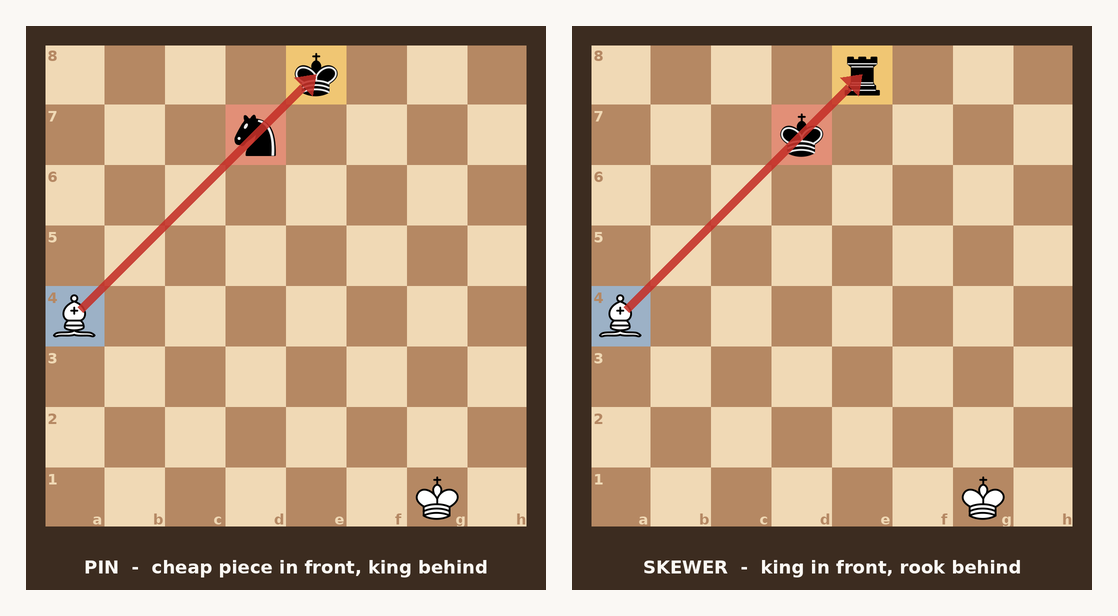
How to read the diagrams
Every board in this article is a legal, engine-checked position. The coloured squares mean the same thing every time:
- Blue — the piece doing the work, or the square it is heading to.
- Red — the piece being attacked directly.
- Amber — the valuable piece behind, or the second piece caught by the same move.
- The red arrow shows the line of attack, or the move that creates the tactic.
One number you need throughout: the standard relative values are queen 9, rook 5, bishop 3, knight 3, pawn 1. Tactics are arithmetic — you are always trading something cheap for something expensive. If those numbers are new to you, start with chess piece values explained.
The Pin: Freezing a Piece in Place
What is a pin in chess?
A pin is an attack on a piece that cannot move away, because a more valuable piece stands directly behind it on the same rank, file or diagonal. The pinned piece is stuck: moving it would either be illegal, or would hand your opponent the bigger piece behind it.
Only three pieces can pin: the bishop, the rook and the queen. A pin needs an attacker that works along an unbroken line, so a knight, a pawn or a king can never pin anything — a fact worth remembering when you are checking whether your own pieces are safe.
Types of pin: absolute and relative
The distinction matters because it changes what the pinned piece is legally allowed to do.
- Absolute pin — the piece behind is the king. Moving the pinned piece would expose the king to check, so it is flatly illegal. The piece cannot move, full stop, no matter how badly you want it to.
- Relative pin — the piece behind is a queen, a rook or any other valuable piece. Moving the pinned piece is legal, it simply costs you material. Sometimes that price is worth paying, and some of the most famous games in chess turn on exactly that decision.
There is also a useful informal category, the situational pin, where the piece behind is not more valuable but the square behind is critical — a mating square, or a square that holds a whole defence together.
Example 1: a relative pin from 1750
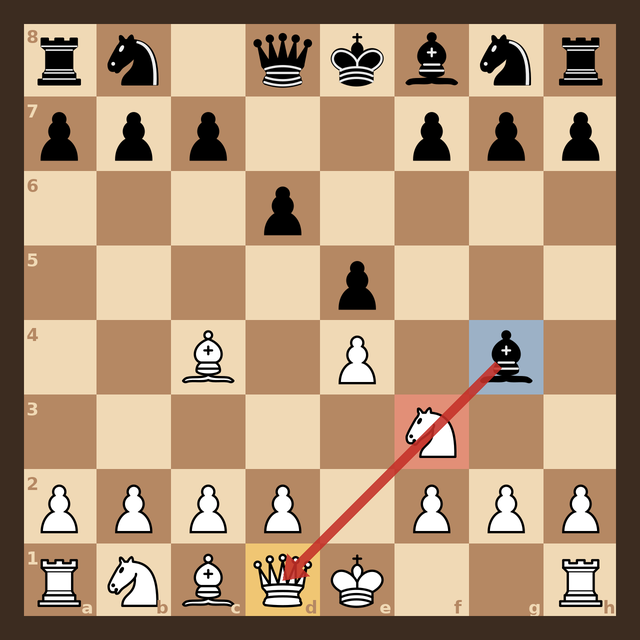
This exact position leads to the oldest famous tactic in chess, played by Legall de Kermur against Saint Brie in Paris, traditionally dated to around 1750. Most players look at f3 and conclude the knight is glued there. Legall did not. After 4.Nc3 g6, he played 5.Nxe5!, moving the pinned knight and apparently just losing his queen.
If Black grabs it with 5…Bxd1, the finish is 6.Bxf7+ Ke7 7.Nd5# — checkmate, which we confirmed is a genuine mate rather than chess folklore. Black's best reply is actually 5…dxe5, declining the queen; Stockfish still rates White close to two pawns better after 6.Qxg4, so the piece sacrifice was sound even against correct defence.
Example 2: an absolute pin in a mainstream opening
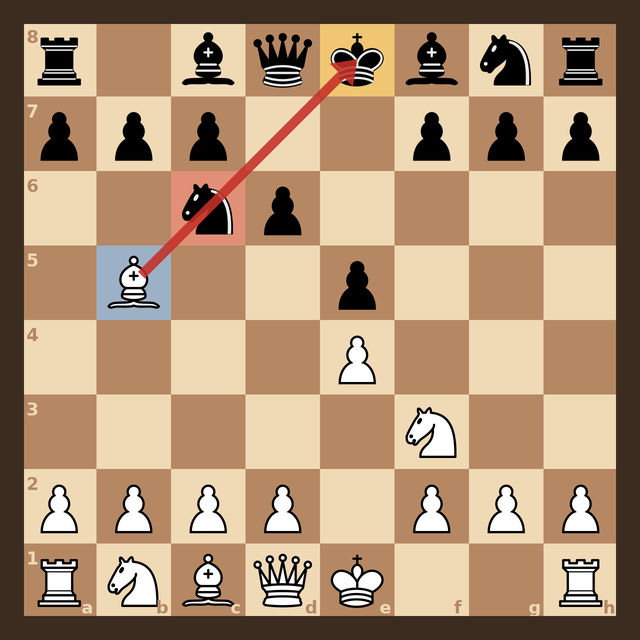
This is worth studying because of a trap in the move order. After 3.Bb5 on its own there is no pin at all: a black pawn still sits on d7, blocking the line. Plenty of beginners are taught that the Ruy Lopez "pins the knight", and it simply does not until Black plays a move like 3…d6 that clears d7. The defence is named after Wilhelm Steinitz, the first official World Champion (1886–1894).
Example 3: how to cash a pin in — pile on
Creating a pin wins nothing by itself. The pinned piece is only a liability once you attack it more times than it can be defended, and it cannot run.
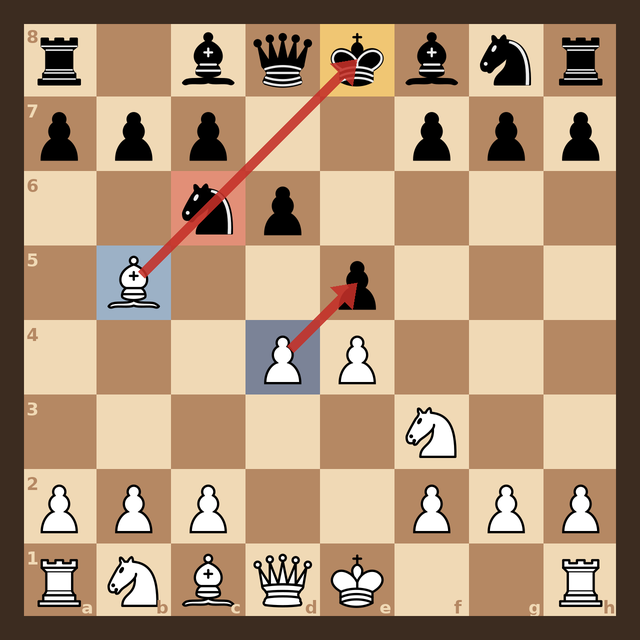
That is the whole technique. Attack the pinned piece again, or attack whatever the pinned piece is defending. A pinned defender is a defender that cannot step aside, so anything relying on it becomes weak too. Stockfish's preference here is 4…exd4, releasing the tension before White can add more attackers, which tells you the pressure is real.
How to spot a pin, and how to escape one
Spotting one: scan for enemy pieces standing on the same line as their own king or queen with nothing in between. Every time your opponent castles kingside, the diagonal to h7 and the file through f7 are worth a glance. Every time their queen sits on the same diagonal as a knight, look at whether one of your bishops can reach that diagonal.
Escaping one — five methods, roughly in order of how often they work:
- Move the piece behind. Get the king or queen off the line and the pin disappears instantly. Usually the cleanest answer.
- Block the line. Interpose a cheaper piece between the pinner and the pinned piece.
- Capture the pinner. Obvious, and regularly overlooked.
- Attack the pinner. A pin costs nothing if the pinning bishop has to spend a move retreating. In the Ruy Lopez, …a6 does exactly this.
- Create a bigger threat. If your opponent is dealing with a check, they have no time to collect your pinned knight.
The Fork: Two Threats, One Move
What is a fork in chess?
A fork is a single move that attacks two or more enemy pieces at the same time. Your opponent gets one move to respond, so they can save one piece and only one. The other is yours.
Unlike the pin and the skewer, every piece on the board can fork, including the king and the pawn. It requires no line and no alignment — just one square that happens to hit two targets.
Types of fork
- Knight fork — the most feared, because a knight's jump cannot be blocked and a knight attacks squares of the opposite colour to the one it stands on. Defenders miss them constantly.
- Royal fork — a knight fork that hits the king and the queen together. The check must be answered, so the queen is simply lost.
- Family fork — the informal name for a knight hitting king, queen and rook at once, usually from c7 or f7.
- Pawn fork — a pawn attacks two squares diagonally. Because the attacker is worth one point, a pawn fork against two pieces almost always wins material outright.
- Queen fork — the queen's range makes it the most frequent forker in practice, often hitting a king on one line and a loose piece on another.
- Bishop, rook and king forks — less common but entirely real, especially in the endgame, where a centralised king forking two pawns decides plenty of games.
Example 1: the royal fork
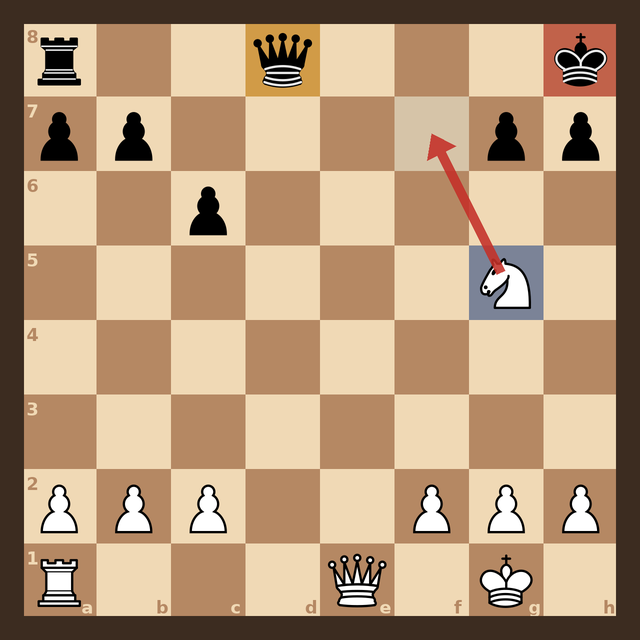
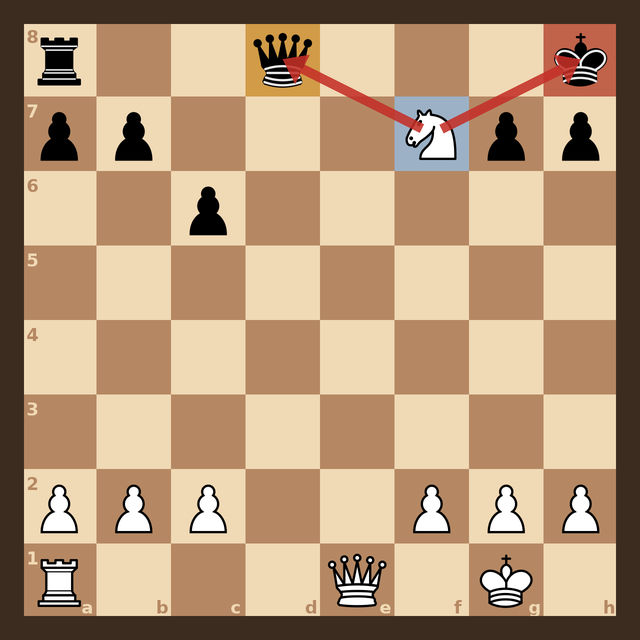
Two details make this work, and both are worth copying. First, the fork comes with check, which removes every defensive resource Black might have had. Second, f7 is not defended — a fork on a square the opponent controls is not a fork, it is a donation. Always check the landing square before you jump.
Example 2: the pawn fork, in a real opening idea
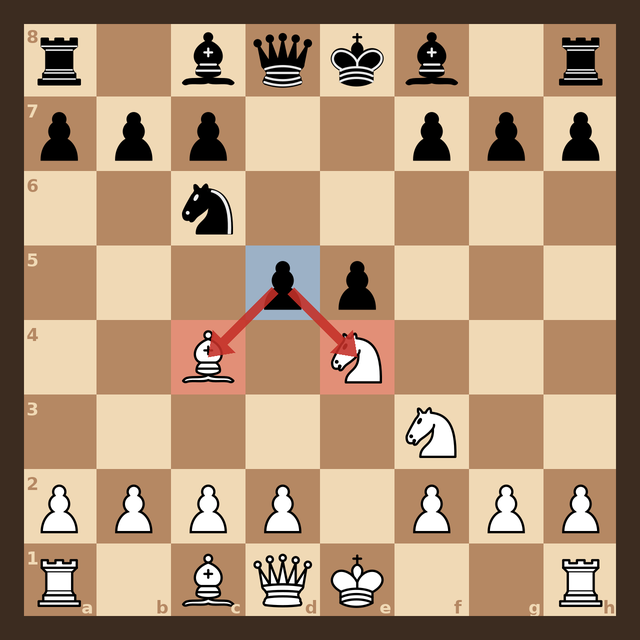
This is a genuine, named opening idea rather than an invented puzzle, and it shows why the pawn is such a nasty forking piece: it is worth one point, so neither the bishop nor the knight can consider capturing it. White's best is 6.Bd3 dxe4 7.Bxe4, after which Black has recovered the piece and Stockfish evaluates the position as dead level. Black's temporary sacrifice was fully sound — because of the fork.
Example 3: the queen fork
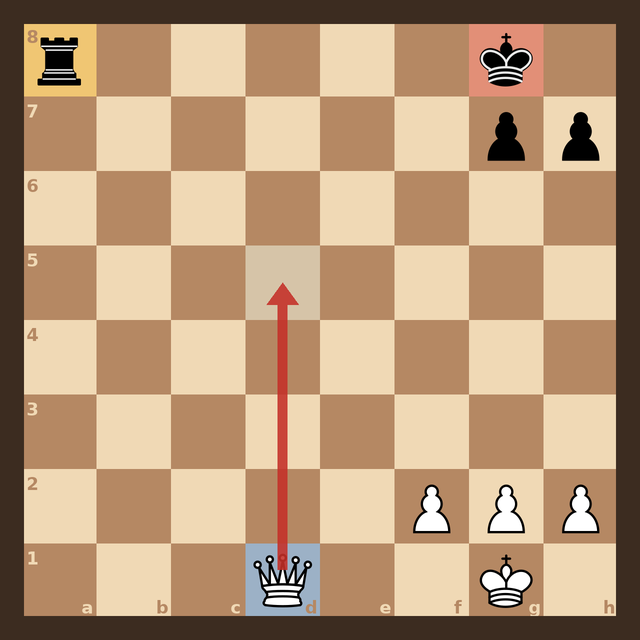
Queen forks nearly always work the same way: a check on one line plus an undefended piece on another. Which is why the practical advice is not "look for queen forks" but "stop leaving pieces undefended". A loose piece is what makes the fork possible in the first place.
How to spot a fork, and how to avoid one
Spotting one: look for two enemy pieces that are a knight's move apart from a common square — with practice this becomes instant recognition rather than calculation. Look hardest when the enemy king and queen are both on the same colour square, because that is exactly what a single knight can hit. And check every enemy piece that is currently undefended, because those are the second target in almost every fork.
Avoiding one:
- Keep your king and queen off the same colour square where you can. It costs nothing and eliminates the royal fork.
- Do not leave pieces loose. Most forks need one defended piece and one undefended one.
- Control the outpost squares a knight would love: f7, c7, e6, d6 and their mirrors. A pawn or a bishop covering those squares kills the tactic before it exists.
- Before every move, ask where the enemy knights can go next. Two seconds of that habit prevents more lost pieces than any opening study.
♔ Try these patterns in a real game
Free live multiplayer chess with rooms, chat and Elo ratings. Open a table and start playing in seconds — no account needed.
The Skewer: The Pin in Reverse
What is a skewer in chess?
A skewer attacks a valuable piece that has a less valuable piece directly behind it on the same line. The front piece is forced to move, and you capture whatever it was shielding. It is the pin with the two victims swapped around, which is why it is sometimes called a reverse pin or a thrust.
As with the pin, only the bishop, rook and queen can skewer, because the tactic depends on attacking along a line.
Types of skewer
- Absolute skewer — the front piece is the king. The move is check, so the king must move, and the piece behind falls with no choice involved at all. This is the version that wins games.
- Relative skewer — the front piece is a queen or rook. It is not forced to move, but staying put costs more than moving.
- Endgame skewer — with fewer pieces on the board, lines open up and kings are exposed, which is why skewers are far more common in endgames than in middlegames.
Example 1: the rook skewer on the back rank
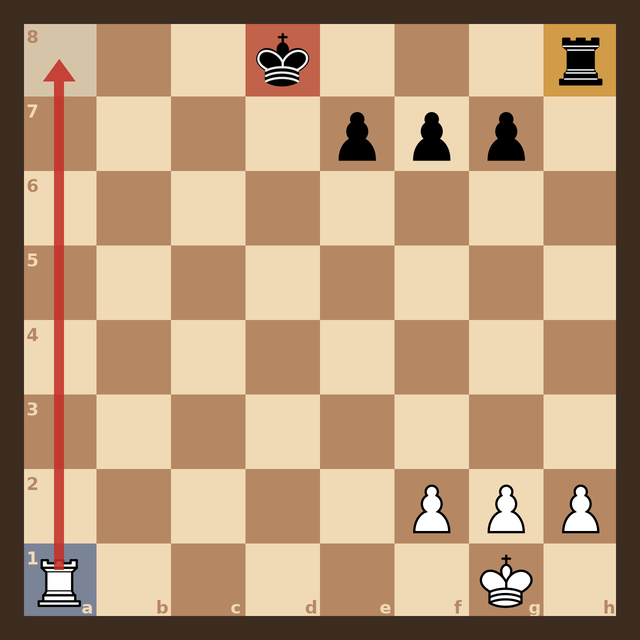
That last detail is the point of the example. Every other first move in this position evaluates as level. One move wins a rook. This is what tactical alertness is actually worth in an endgame.
Example 2: the bishop skewer
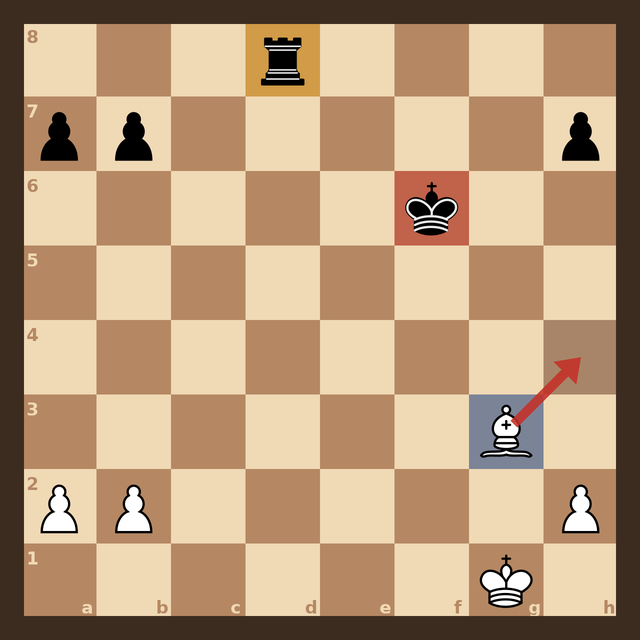
Notice what had to be true for this to work: no black piece could interpose on g5 or e7. A skewer is defeated by a block just as easily as a pin is, so before you play one, check every square on the line between the two enemy pieces.
How to spot a skewer, and how to avoid one
Spotting one: the trigger is an enemy king or queen with anything at all lined up behind it. In endgames, get into the habit of checking every rank, file and diagonal that the enemy king stands on. Skewers hide in plain sight because most players scan for what is in front of a piece, not what is behind it.
Avoiding one:
- Do not line your king up with your own rook or queen on an open file, rank or diagonal, even when nothing is attacking yet.
- Keep a blocker available so a check can be met by interposing rather than by moving.
- In endgames, activate the king carefully. An exposed king on an open board is the raw material of every skewer.
Pin vs Fork vs Skewer: The Comparison Table
| Pin | Fork | Skewer | |
|---|---|---|---|
| What happens | A piece is frozen because something more valuable is behind it | One move attacks two or more pieces at once | A valuable piece is attacked and forced to move, exposing what was behind it |
| Which pieces can do it | Bishop, rook, queen only | Every piece, including king and pawn | Bishop, rook, queen only |
| Piece order on the line | Cheap in front, valuable behind | No line needed at all | Valuable in front, cheap behind |
| Typical material won | Often nothing immediately — you must pile on. Then the pinned piece | The smaller of the two attacked pieces, usually 3 to 9 points | The piece behind, immediately. Often a full rook or queen |
| Wins straight away? | No, it sets up the win | Usually yes, on the next move | Usually yes, on the next move |
| How to defend | Move the piece behind, block, capture or attack the pinner, or counterattack | Cover the forking square, defend loose pieces, keep king and queen on different colours | Block the line, or avoid lining up king and rook in the first place |
| Where it shows up most | Openings and middlegames | Everywhere, especially tactical middlegames | Endgames, where lines are open |
Common Mistakes Players Make With These Tactics
- Treating a relative pin as absolute. A knight pinned to a queen can still move. Legall's game from 1750 is the whole argument, and the same idea shows up in club games every day.
- Creating a pin and then doing nothing with it. A pin is a setup, not a payoff. If you are not adding attackers to the pinned piece or attacking what it defends, the pin will just be dissolved on the next move.
- Adding a defender to a pinned piece instead of moving the piece behind. Defending it keeps the problem. Moving the king or queen off the line deletes it.
- Forking onto a defended square. If your opponent controls the landing square, a knight fork is a free knight for them. Check the square, then jump.
- Leaving pieces undefended. Nearly every queen fork and most skewers need one loose piece to exist. Loose pieces drop off — the old saying is old for a reason.
- Lining up your own king with your own rook or queen. You are pre-building your opponent's skewer for them, often several moves before they notice.
- Forgetting that skewers can be blocked. Before playing the check, look at every square between the two enemy pieces. If one of their pawns can interpose, there is no tactic.
- Only looking for your own tactics. The habit that matters most is checking, before every single move, whether the move you are about to play walks into a fork, pin or skewer. More on this in 5 common mistakes every chess beginner makes and why do I keep losing at chess.
How to Practise Pins, Forks and Skewers
Tactical vision is pattern recognition, and pattern recognition is built by repetition, not by reading. Three things work, in this order:
- Short daily puzzle sessions. Fifteen minutes every day beats two hours once a week, because you are training recall rather than understanding. Our daily chess puzzles are a place to start, and Lichess Puzzles has a free, enormous, rating-adjusted database if you want volume.
- Play slow games and check every move. Before you release a piece: does this line two of my pieces up? Does this leave anything loose? Where can their knights jump? Blitz will not build this habit — longer time controls will.
- Review your losses. Find the exact move where material went, and name the tactic that took it. After twenty games you will notice you keep losing to the same one, and that is the pattern to drill.
Once the patterns are automatic, the natural next step is putting them to work in real games. If you are tracking progress, what counts as a good chess rating gives a realistic picture of where tactical improvement usually shows up on the scoreboard, and the best chess openings for beginners covers getting to a playable middlegame in the first place.
♟ Put it into practice now
Play live against real people, work through puzzles, or take on the computer at your own level. Everything below is free.
Frequently Asked Questions
They use exactly the same geometry — an attacker, and two enemy pieces lined up behind each other on one rank, file or diagonal. The only difference is which one stands in front. In a pin the less valuable piece is in front and is frozen by the more valuable piece behind it. In a skewer the more valuable piece is in front: you attack it, it has to move, and you take what it was shielding. That is why a skewer is sometimes called a reverse pin.
An absolute pin is one where the piece behind is the king. Moving the pinned piece would expose the king to check, which is illegal, so it genuinely cannot move. A relative pin has a queen or rook behind instead — moving is legal there, it just usually costs material.
Only the sliding pieces: bishop, rook and queen. Both tactics need an attacker working along an unbroken line, so a knight, a pawn or a king can never pin or skewer anything. Forks are different — every piece on the board can deliver one.
The knight. Its jump cannot be blocked, and it always attacks squares of the opposite colour to the one it is standing on, which is why defenders keep missing them. A knight fork hitting the king and queen together is a royal fork. The pawn is a close second: it attacks two squares diagonally and costs one point, so a pawn fork against two pieces nearly always wins material outright.
Five options: move the valuable piece behind out of the line, block the line with a cheaper piece, capture the pinning piece, attack the pinning piece so it must retreat, or create a bigger threat elsewhere. In an absolute pin the first is usually the only reliable one, because the pinned piece itself cannot legally move.
Yes, and it is the most dangerous version. When a fork hits the king and another piece, the check has to be answered first, which hands the attacker a free move to take the second piece. That is why forks delivered with check are so much stronger than forks without.
Below roughly 1500 they matter more than anything else. Most club games are not decided by an opening novelty or a deep endgame plan — they are decided when one side drops a piece to a tactic. Recognising these three patterns instantly, and checking for them before every move, removes a large share of those losses.
Solve puzzles in short daily sessions rather than long weekly ones, because you are training recall. Then add a check to your own games: before you release a piece, ask whether the move lines two of your pieces up on one line, and whether any enemy knight has a square that hits two things at once.
Sources and further reading
- Pin (chess) — Wikipedia
- Fork (chess) — Wikipedia
- Skewer (chess) — Wikipedia
- Legall Trap — Wikipedia
- Lichess Puzzles — free tactical training
- Lichess Practice — interactive lessons
Method note: every position in this article was set up as a legal board, checked for pins with the python-chess library, and analysed with Stockfish 16 at search depth 22–24. Where the text says a move wins material or is the best move, that is the engine's assessment of the position shown, not an estimate.
Final Thoughts
Pins, forks and skewers are not advanced chess. They are the vocabulary of the game, and the reason they win so many points is that most players below master level are only half-looking for them — hunting for their own tactics while forgetting to check for their opponent's.
The two habits worth taking away are small. Before you move, look at your own pieces and ask whether any two of them are lined up on the same rank, file or diagonal. Then look at your opponent's and ask the same thing. That is where every pin and every skewer starts. Add "where can their knights go next" and you have covered the fork too.
For more chess guides, see the ChessDada Chess Blog, or start a game right now in the lobby.