10 Chess Tips and Tricks for Players Coming Back After Years Away
⚡ The Short Version
- Play 1.e4 or 1.d4, get your knights and bishops out, and castle by move ten. That is the whole opening.
- Before every move, ask one question: is anything of mine attacked and undefended? This single habit wins more games than anything else on this page.
- Learn three tactics only — pin, fork, skewer. They decide most casual games.
- Start at 10+5, not blitz. Speed comes back on its own.
- After a loss, find one mistake. Not five. One.
📜 On this page
- Take the center in your first three moves
- Knights and bishops out early, queen stays home
- Castle within the first ten moves
- Two seconds before every move
- Know what the pieces are worth
- Learn three tactics only
- Do not rush your pawns forward
- In the endgame your king is a fighting piece
- Manage your clock
- After every loss find exactly one mistake
- Piece values at a glance
- What changed since the Yahoo Chess days
- Where to practice these tips
- Frequently asked questions
You used to play chess in the evenings. Maybe in a room on Yahoo Chess, with the table list on one side and people chatting in the corner. Then Yahoo shut the games down in 2014, everyone drifted off, and somehow you have not moved a piece since. If that is you, here is the full story of what happened to Yahoo Chess.
Almost nothing has to be relearned. The rules are still in your head. What you lost is board vision — noticing what your opponent is threatening before you press the button. These ten chess tips and tricks aim straight at that. Nothing to memorise, no grandmaster theory. Follow them and most casual players are back to a decent level within a couple of weeks.
1Take the Center in Your First Three Moves
The four middle squares — d4, d5, e4, e5 — are worth more than anything else early on. A knight in the center covers eight squares. The same knight in the corner covers two.
So open with a pawn in the middle: 1.e4 or 1.d4. Both are fine and both have been played by every world champion. As Black, answer in the middle too — 1.e4 e5 or 1.d4 d5.
A healthy opening looks like 1.e4 e5 2.Nf3 Nc6 3.Bc4. Three moves, a pawn in the center and two pieces aimed at it. That is all the theory you need.
2Knights and Bishops Out Early, Queen Stays Home
The most common mistake by returning players is bringing the queen out on move two to hunt something. It feels aggressive. It is a gift.
She is worth nine points, so every cheap piece can chase her, and each time she runs your opponent develops for free. After 1.e4 e5 2.Qh5, Black plays 2...Nc6 and 3...g6 — two pieces out for Black, a queen running for cover for White.
Do it the other way round: knights, then bishops, then castle, queen later. A simple order that works every game — Nf3, Nc3, Bc4, Be3, O-O.
3Castle Within the First Ten Moves
Castling does two things in one move: it tucks the king behind a wall of pawns and brings a rook toward the center. Nothing else in chess gives you two benefits for one move.
Kingside (O-O) is the normal choice — only the knight and bishop have to move out of the way. Queenside (O-O-O) costs an extra move but puts the rook straight on the d-file.
Set a hard rule: if it is move ten and you have not castled, castle now. Games where the king is still sitting on e1 on move fifteen end suddenly and badly.
4Two Seconds Before Every Move: Is Anything of Mine Hanging?
This is the most valuable tip on the page, and it is not chess knowledge at all. It is a habit.
A hanging piece is one that is attacked and undefended. At casual level most games are decided by somebody leaving a piece hanging, not by clever plans.
So before you move, look over your own pieces and ask which ones are attacked. Then ask what your intended move leaves undefended. After 1.e4 e5 2.Nf3 Nc6 3.Bc4 Nf6 4.Ng5, Black has to notice that f7 is now attacked twice and defended once. Miss it and you lose a pawn and your castling rights by move six.
5Know What the Pieces Are Worth
Pawn 1, knight 3, bishop 3, rook 5, queen 9. The king has no number because you can never trade it. You remember these, but trades are where returning players quietly lose games.
Use the numbers when deciding a trade. A bishop (3) for a rook (5) gains two points — that is winning the exchange, usually enough to win the endgame. A rook for a knight loses it, so you need a concrete reason.
Two things the numbers hide: bishops improve as the board opens, so a pair is worth more than 6; and a passed pawn one square from promotion is worth far more than 1.
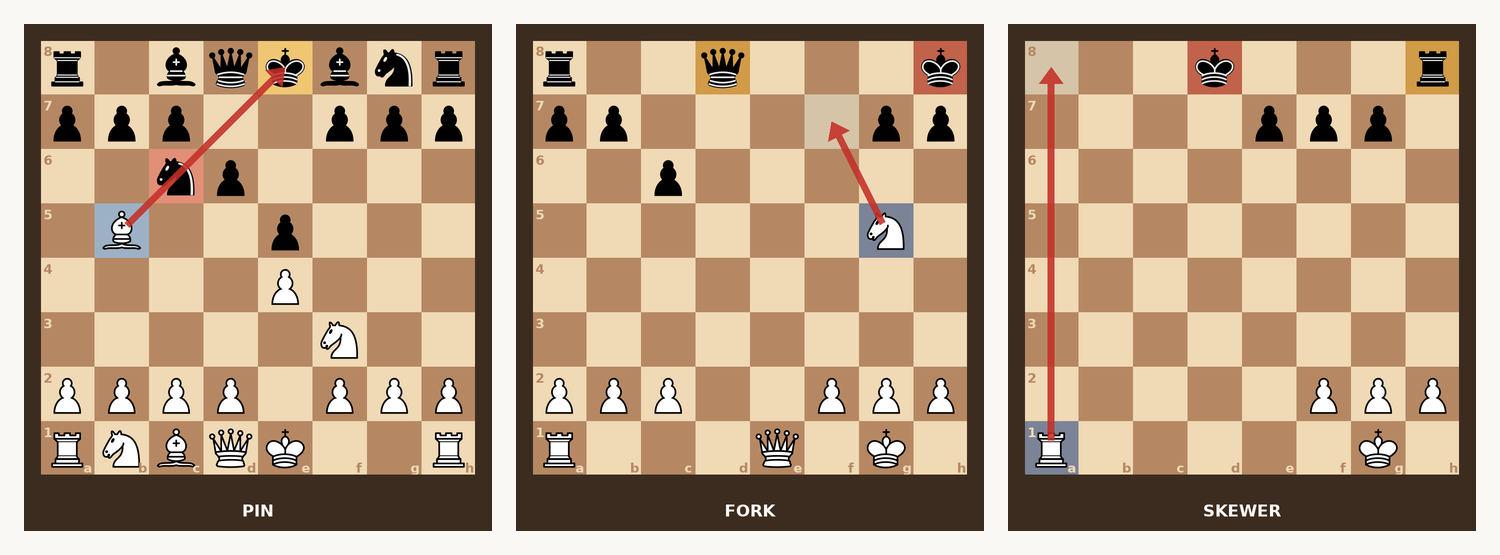
6Learn Three Tactics Only: Pin, Fork, Skewer
There are dozens of named tactics. Three of them cover most of the material that changes hands in casual games.
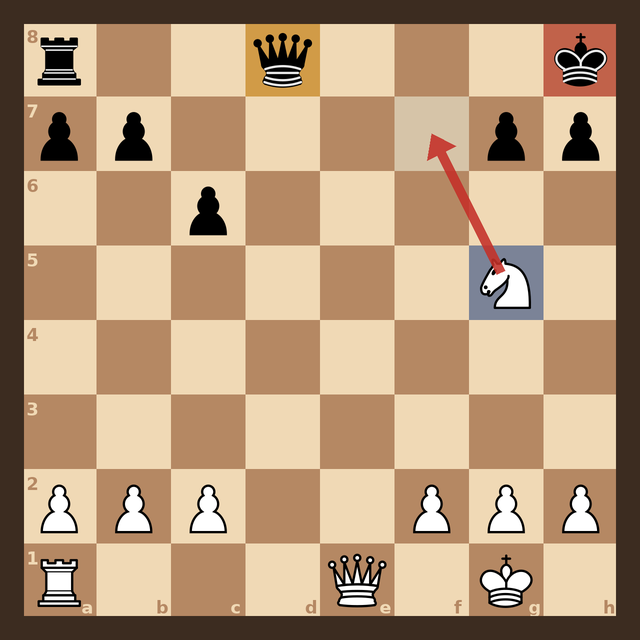
A fork is one piece attacking two things at once. The knight is the great forker because it jumps — a knight hitting king and queen together wins the queen, because the check must be answered first.
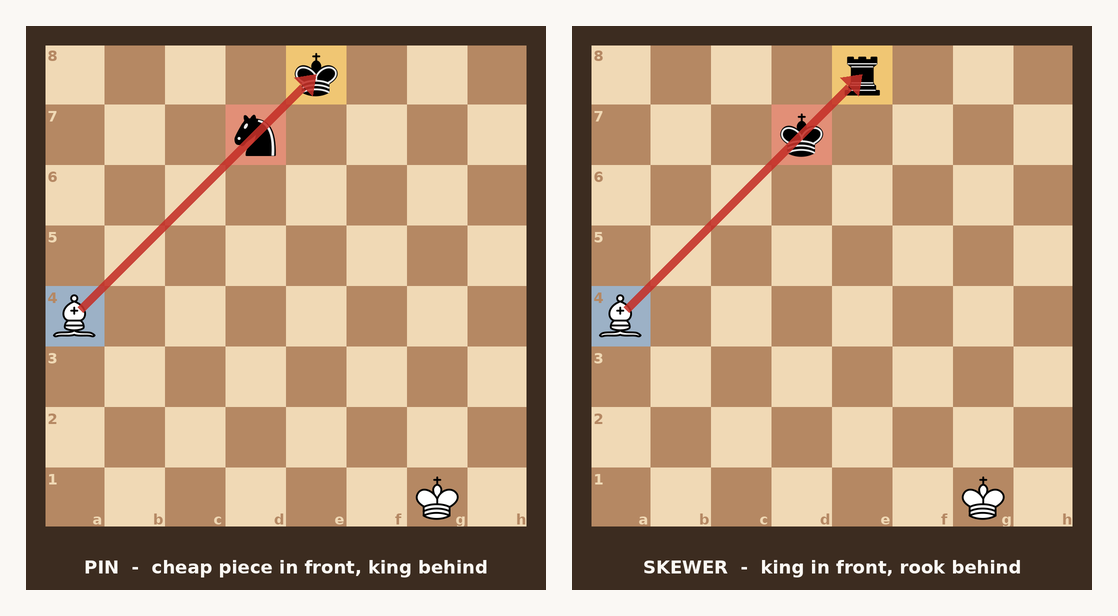
A pin freezes a piece because something more valuable sits behind it: after 1.e4 e5 2.Nf3 Nc6 3.Bb5 the bishop leans on the c6 knight. A skewer is the same line reversed — the valuable piece is in front, it has to move, and you take what stood behind it.
Once you see these three you also start spotting them aimed at you. Our library of chess opening traps shows dozens of short games where exactly these patterns end things inside fifteen moves.
7Do Not Rush Your Pawns Forward
Pawns are the only pieces that cannot go back. Every pawn move is permanent, so every pawn move leaves a hole that stays there for the rest of the game.
The habit to break is pushing pawns to chase pieces away. A bishop appears on g4 and the instinct is h3, then g4 — two moves spent, and the kingside cover gone right where your king is about to castle.
Two pawn moves in the opening is usually right, three sometimes. Beyond that, develop a piece instead. Later, push a pawn for space you can actually use or to make a passed pawn — not because a piece annoyed you.
8In the Endgame Your King Is a Fighting Piece
All game you have kept the king safe. Once the queens come off that changes completely, and this is where returning players leave the most points on the table.
With few pieces left there is nothing to mate you quickly, so the king can walk — and it should. An active king in an endgame is worth roughly a knight, and it is the piece that escorts your passed pawn home or stops theirs.
King and pawn against king is the classic case: push the pawn alone and it is usually a draw; walk the king in front of it first and it usually promotes. Same pieces, different result, one habit.
9Manage Your Clock (Play the First Ten Moves Fast)
Online chess is timed, and losing on time is the most annoying way to lose a game you were winning.
Spend your time where it matters. The first ten moves should take almost none — you already know the plan. Save the thinking for the moment pieces make contact and there is something real to calculate.
Start at 10+5, ten minutes each plus five seconds a move: slow enough to run your blunder-check and still finish inside half an hour. Drop to 5+3 once the check is automatic. Do not start with 1-minute bullet — it teaches you to move fast, not to move well.
10After Every Loss Find Exactly One Mistake
Not five. One. People who review a whole game after every loss give up within a week; people who review nothing repeat the same mistake for years.
Play the game back and find the single move where it went wrong — usually where you dropped a piece or missed a threat. Say it in one sentence: "I moved my knight and forgot it was defending g5." That sentence is the lesson.
If you want the practice without an opponent, work through a daily chess puzzle. One a day is enough — it is the same skill as tip four with the pressure removed.
Piece Values at a Glance
| Piece | Value | Quick note |
|---|---|---|
| Pawn | 1 | Cannot move backwards. Worth far more one square from promotion. |
| Knight | 3 | Jumps, so it forks well. Strongest near the center. |
| Bishop | 3 | Gets better as the board opens. A pair is worth over 6. |
| Rook | 5 | Wants open files and the seventh rank. |
| Queen | 9 | Strongest piece — but do not bring her out early. |
| King | — | Never traded, so no value. Worth about a knight in the endgame. |
What Changed Since the Yahoo Chess Days
If your last games were on Yahoo, here is an honest comparison.
| Then (2000s Yahoo Chess) | Now on ChessDada |
|---|---|
| Rooms by level, with a list of open tables to sit at | The same idea, kept on purpose — Beginner, Intermediate and Advanced rooms, open tables, chat at the table |
| A rating that meant something only inside Yahoo | Elo ratings updated after every rated game, plus a game history |
| A handful of fixed time controls | Anything from 1 to 99 minutes, with up to 30 seconds increment per move |
| Yahoo ID required before you could sit down | No signup — play as a guest, sign in later if you want the rating saved |
| Desktop only, and Java had to be working | Any browser on phone, tablet or desktop, plus an Android app |
| Free, then gone in 2014 | Free, no ads on the board, no paid tier for playing |
The one thing genuinely gone is the size of the crowd. Yahoo had thousands in a room at peak time and a newer site does not, which is why inviting one friend matters more than it used to.
Where to Practice These Tips
Reading tips does little on its own — these are habits, and habits form over real games. The quickest start is to play free online chess in the browser with no account. Pick a 10+5 table and give yourself ten games before judging how rusty you are.
When you want a live opponent, join a table in whichever room matches your level. Between games, one daily chess puzzle and a browse through the chess opening traps will sharpen your pattern recognition faster than more reading.
♙ Sit Down at a Table, Free
Classic rooms, real opponents, Elo ratings and chat — no download, no signup needed.
None of it is complicated, and that is the point. Center, development, castle, then check for hanging pieces every move. Three tactics. Careful pawns. An active king. A sensible clock. One lesson per loss.
Chess waited for you. The pieces move exactly as they did the last time you sat down. Open a table, play ten games, and see how fast it comes back.
Frequently Asked Questions
Take the centre in your first three moves, develop knights and bishops before the queen, castle inside ten moves, and check for hanging pieces before every move. Those four habits recover most of the strength a casual player loses over a long break.
Usually two to three weeks of regular games. The rules never leave you. What you lose is board vision, and that returns quickly once you are playing again.
No. Below roughly 1500, games are decided by hanging pieces and missed tactics, not opening theory. Centre, development and castling are enough to reach a playable middlegame every time.
Pawn 1, knight 3, bishop 3, rook 5, queen 9. The king has no value because it cannot be traded. Bishops are worth slightly more than 3 when they come as a pair in an open position.
Three: the pin, the fork and the skewer. They account for most of the material won in amateur games, and learning them properly beats any amount of opening study.
10+5, or ten minutes a side. It leaves room to check for blunders without the game dragging. Move down to 5+3 once the blunder-check is automatic.
Was this article helpful?